
Scientific Name: Charadrius vociferus
Diet: Killdeer eat a variety of invertebrates. They eat earthworms, snails, crayfish, grasshoppers, and beetles. Sometimes Killdeer eat seed, but their main diet is invertebrates.
Habitat: The Killdeer is a shorebird, but you can find it in dry places as well as around water. Killdeer live on mudflats and sandbars. They also live in towns though–Killdeer have been known to nest in gravel in the middle of town in round-a-bouts. Killdeer can be found on lawns, athletic fields, and driveways and in city parks.
Range: Killdeer can be found through much of Washington year-round, but at the far eastern edge they can only be found during the breeding season. They also live year-round in the western and southern U.S., and during the breeding season they live in the mid-northern and north-eastern U.S.
Sound: The Killdeer’s calls include a many variations of something that sounds like killdeer! The flight call is a quick, repeated killdeer!killdeer!killdeer!. Killdeer are named for their calls.
Nesting: The Killdeer’s nest isn’t fancy. All it is is a small depression about three inches across. They scrape the depression in wood chips or gravel. The nest is often in the open, but all the same the eggs are well concealed. You can barely tell they are eggs, because they look like rocks. At the large end the egg is heavily speckled, and the speckling thins as it goes up the egg. There are three to six eggs in a clutch, and incubation lasts twenty-two to twenty-eight days.
Behavior: While foraging Killdeer are often seen running and walking along the ground and probing with their bills into the mud or grass. If an intruder comes to close to a Killdeer’s nest the Killdeer will pretend it has a broken wing, so the predator will be lured away from the nest and toward the Killdeer. When the predator is far enough from the nest the Killdeer will get up and fly away.
Description/field marks: The Killdeer is a beautiful bird. It has two black bands on the breast. Killdeer are brown above and white below. The bird you would most likely confuse it with is the Semipalmated Plover. This shorebird has only one breast band. The Killdeer has a white stripe above its eye, and the Semipalmated Plover does not.
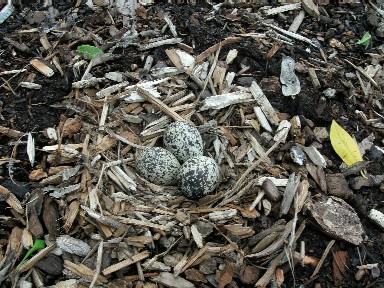
Killdeer Nest